
Bird Construction Inc. (TSX: BDT) (OTC: BIRDF) – Q2 2025 Earnings
Bird Construction Inc. (TSX: BDT) (OTC: BIRDF) – Q2 2025 Earnings
Earnings Release Date: Aug. 13, 2025 (all figures in Canadian dollars)
Stock Price: $30.08
Market Cap: $1.7 billion
Q2 2025 sales of $850.8 million vs $873.5 million in the prior year
Q2 2025 adjusted EPS of $0.50 vs $0.43 in the prior year
Press Release vs Call Transcript Comparison
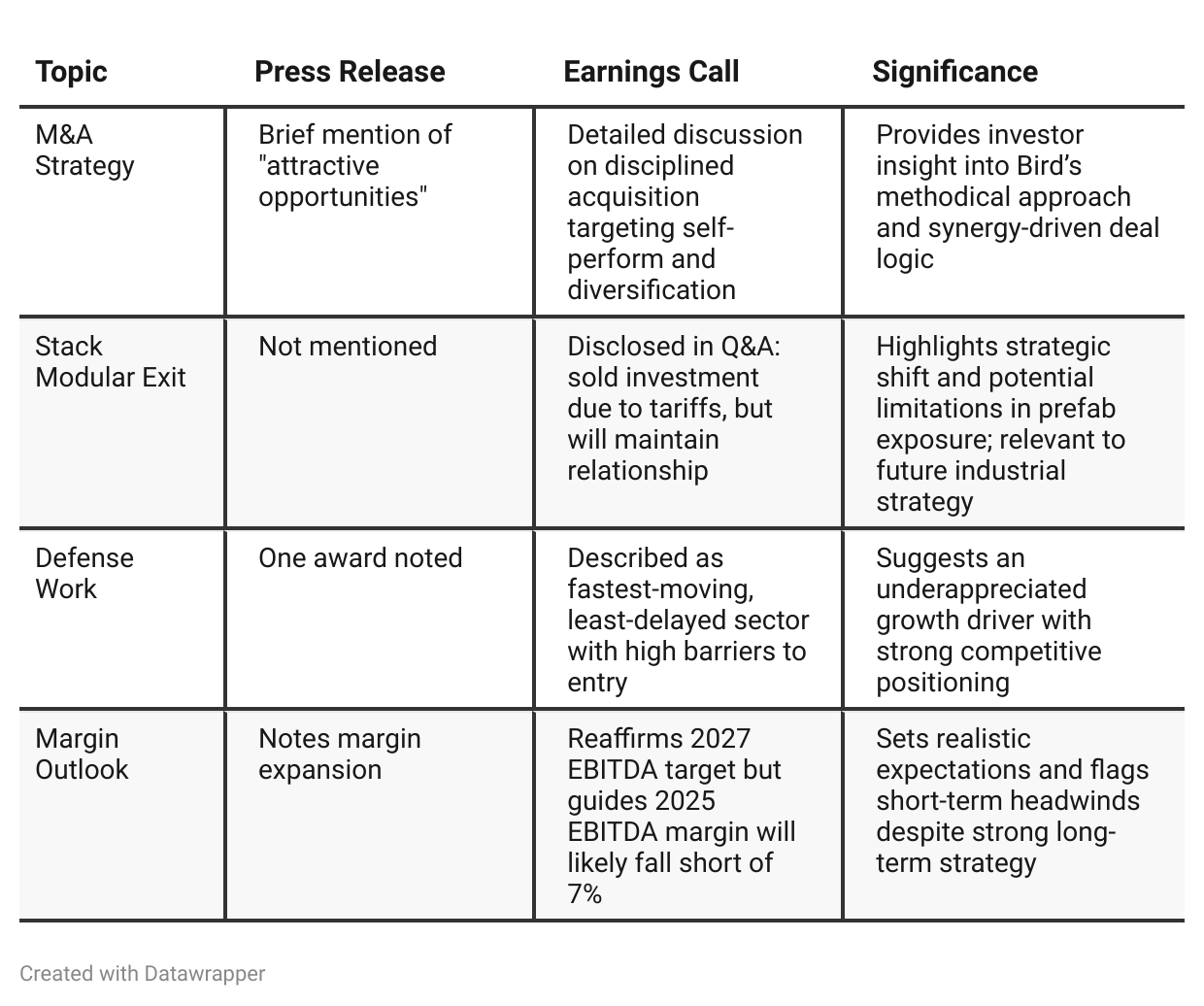
While the press release emphasizes Bird Construction's strong backlog, margin gains, and new project wins, the earnings call adds meaningful depth around operational headwinds, customer behavior, and Bird’s forward strategy.
Notably, the call reveals the true scale of revenue softness (~10% organic decline), specifics on project delays (industrial-focused, client-driven), and the company's focus on risk-mitigated M&A and defense growth.
These differences are significant: the press release supports a bullish surface narrative, but the earnings call provides the nuanced context investors need to properly assess execution risk, timing of revenue conversion, and the strength of Bird’s strategic positioning in a volatile macro environment.
Positive Insights
Negative Insights
Tariff Risk
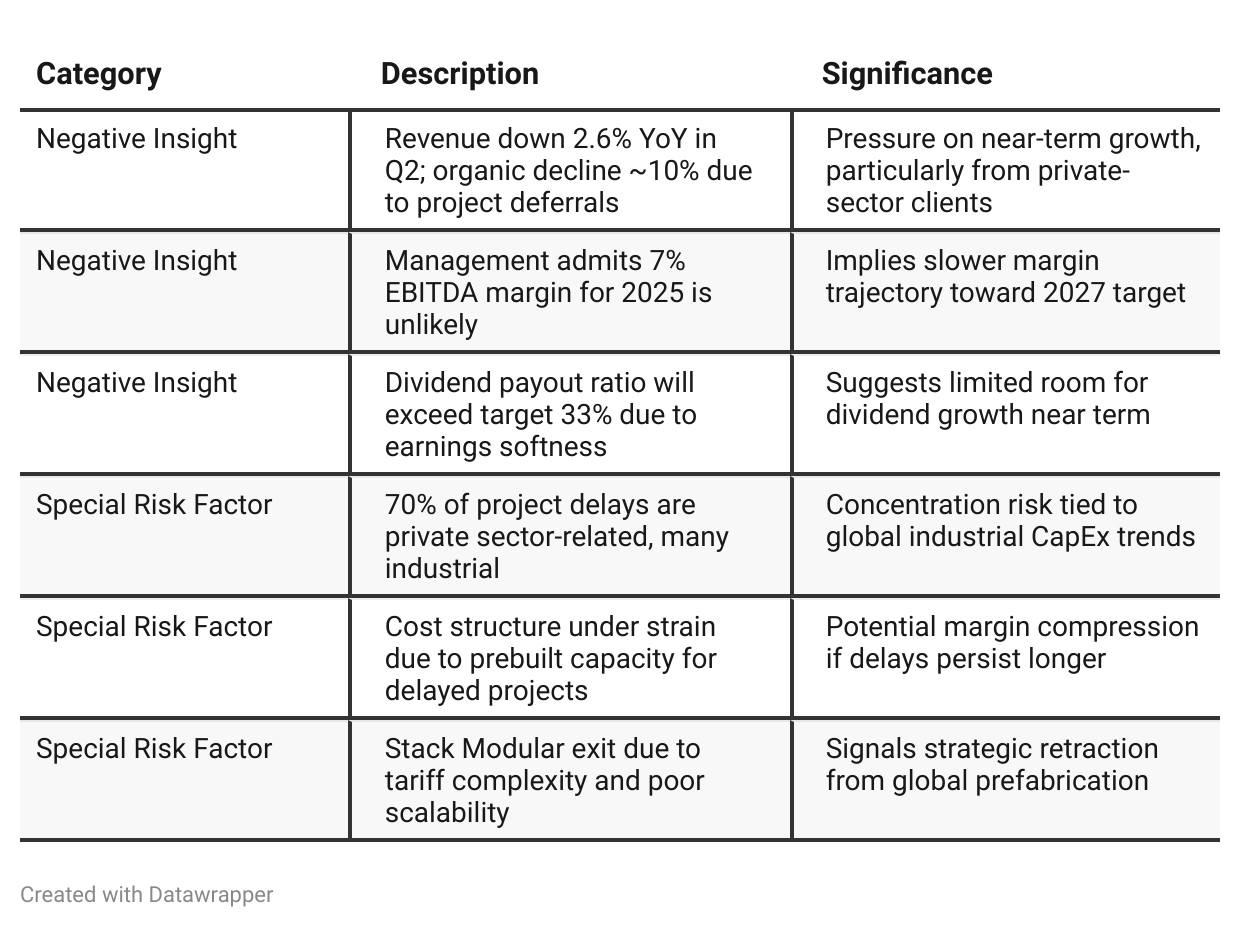
Management explicitly tied client delays and revenue pressure to uncertainty around tariffs and global trade policies, particularly in industrial segments and modular construction.
Bird exited its investment in Stack Modular due to escalating difficulties sourcing Chinese steel-based modules—underscoring the disruptive impact of tariffs on strategy. Clients are hesitant to proceed without clarity on input costs and global trade rules (e.g., CUSMA renegotiation).
While Bird is partially insulated due to collaborative project models (clients bear most cost pressure), this insulation also leads to project pauses rather than adjusted pricing. Management sees potential upside should a trade deal be reached, which could unlock backlogged demand and ease margin pressure.
Previous Earnings Call
Quarter-over-quarter comparison
From Q1 to Q2 2025, Bird Construction's narrative shifted from one of strong momentum and strategic execution to cautious navigation through macroeconomic headwinds.
While the company reaffirmed its long-term targets (particularly the 8% adjusted EBITDA margin by 2027), the near-term tone became more defensive as revenue growth softened due to client-driven delays.
Despite these delays, Bird continued to win new work, particularly in defense and clean energy sectors, and emphasized that its collaborative delivery model helped shield margins. The overarching story: operational strength and strategic positioning remain intact, but short-term visibility is challenged by external uncertainties.Year-over-year comparison
Between Q2 2024 and Q2 2025, Bird Construction’s narrative transitioned from aggressive growth to disciplined execution under economic uncertainty. The Q2 2024 call emphasized booming revenue, expanding margins, and strategic acquisitions like Jacob Bros as part of a long-term growth plan.
By Q2 2025, although margin accretion continues, revenue momentum has slowed due to widespread customer delays, especially in industrial sectors. Management remains confident in its 2027 goals, highlighting record backlog quality, collaborative contracting, and strategic sector alignment.
However, they now caution that the path forward will be less linear, with macro and geopolitical developments playing a critical role in determining timing for resumed growth. The story has evolved from acceleration to measured resilience — still bullish, but more grounded in managing external risks.
Final Takeaway
Bird Construction is in a margin-expansion phase, focusing on defense, energy, and infrastructure projects aligned with national priorities.
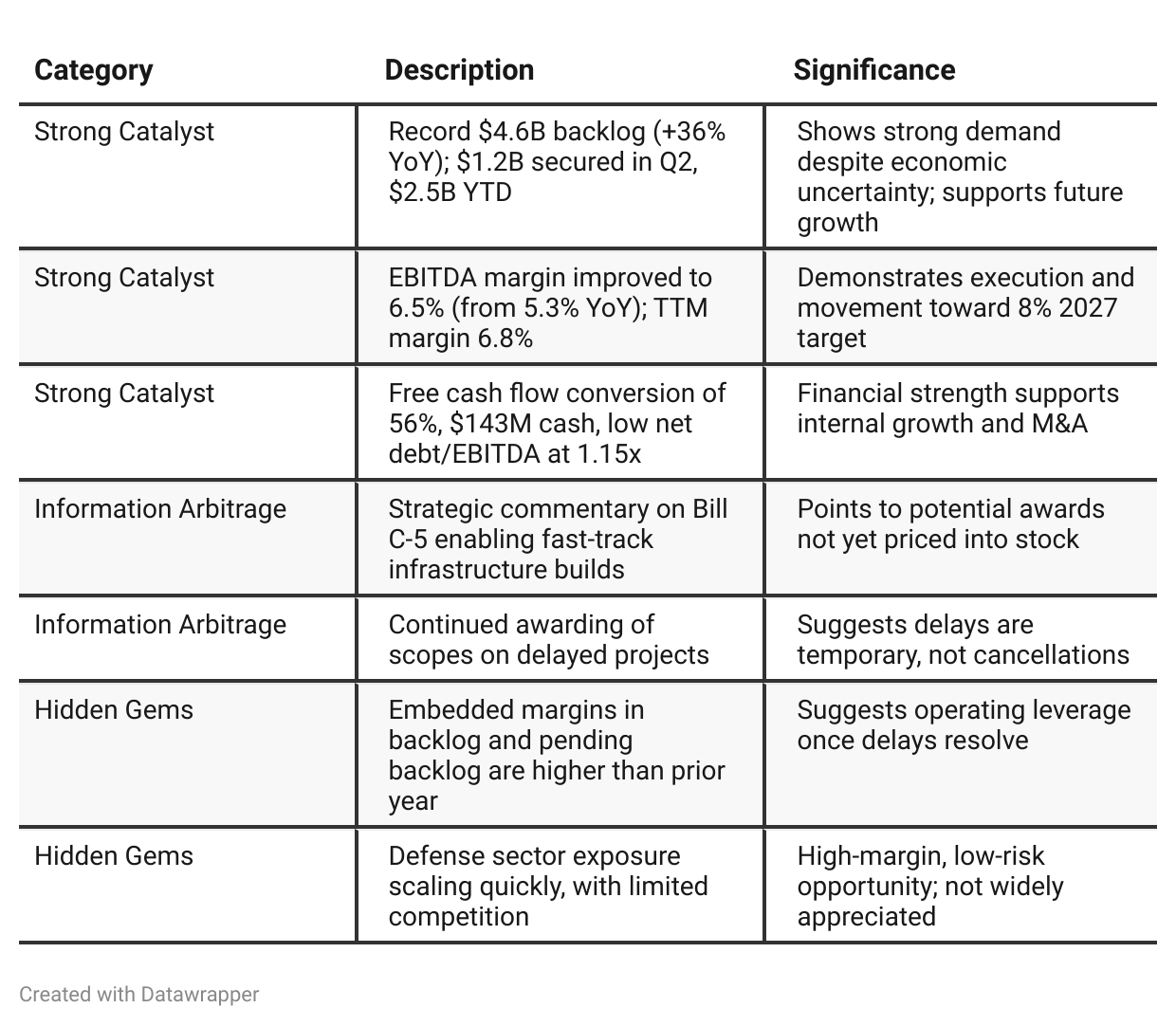
While record backlog and EBITDA progress support long-term upside, near-term revenue softness from client delays and tariff-related uncertainty constrain growth. Execution on large-scale projects and easing of macro headwinds will be critical.
Verdict: Hold, with upside tied to project reactivation and trade clarity.